
2025–26 Annual Report
ISSN 1925-7732
Click to view the report in PDF.
Table of Contents
Letters
The Honourable Raymonde Gagné, Senator
Speaker of the Senate
Senate of Canada
Ottawa, Ontario K1A 0A4
Dear Speaker:
I have the honour of presenting you with the Office of the Public Sector Integrity Commissioner of Canada’s Annual Report for the fiscal year ending March 31, 2026. This report is to be laid before the Senate in accordance with the provisions of section 38 of the Public Servants Disclosure Protection Act.
The Annual Report is to be referred to the Standing Senate Committee on National Finance pursuant to subsection 38(4) of the Act.
Yours sincerely,
(Original signed by) Harriet Solloway
Public Sector Integrity Commissioner
Ottawa, June 2026
C.c.: Ms. Shaila Anwar, Clerk of the Senate and Clerk of the Parliaments
The Honourable Francis Scarpaleggia, M.P.
Speaker of the House of Commons
House of Commons of Canada
Ottawa, Ontario K1A 0A6
Dear Speaker:
I have the honour of presenting you with the Office of the Public Sector Integrity Commissioner of Canada’s Annual Report for the fiscal year ending March 31, 2026. This report is to be laid before the House of Commons in accordance with the provisions of section 38 of the Public Servants Disclosure Protection Act.
The Annual Report is to be referred to the Standing Committee on Government Operations and Estimates pursuant to subsection 38(4) of the Act.
Yours sincerely,
(Original signed by) Harriet Solloway
Public Sector Integrity Commissioner
Ottawa, June 2026
Public Servants Disclosure Protection Act
The federal public administration is an important national institution and is part of the essential framework of Canadian parliamentary democracy. It is in the public interest to maintain and enhance public confidence in the integrity of public servants. Confidence in public institutions can be enhanced by establishing effective procedures for the disclosure of wrongdoings and for protecting public servants who disclose wrongdoings, and by establishing a code of conduct for the public sector. Public servants owe a duty of loyalty to their employer and enjoy the right to freedom of expression as guaranteed by the Canadian Charter of Rights and Freedoms and that this Act strives to achieve an appropriate balance between those two important principles.
— Excerpt from the Preamble
Our Raison d’être
Established in 2007 under the Public Servants Disclosure Protection Act, the Office of the Public Sector Integrity Commissioner of Canada (the Office) is an independent organization that strengthens accountability in the federal public sector. It investigates and exposes major wrongdoing through reports to Parliament, and investigates complaints of reprisal.
Our Vision
A premier investigative and decision-making body, known for its impartiality and fairness, the Office acts as an agent of Parliament in the public interest to expose major wrongdoing in the federal public sector.
Our Values
| Respect for Democracy | We recognize that elected officials are accountable to Parliament, and ultimately to the Canadian people, and that a non-partisan public sector is essential to our democratic system. |
|---|---|
| Respect for People | We treat all people with respect, dignity and fairness. This is fundamental to our relationship with the Canadian public and colleagues. |
| Impartiality | We arrive at impartial and objective conclusions and recommendations independently. |
| Integrity | We act in a manner that will bear the closest public scrutiny. |
| Stewardship | We use and care for public resources responsibly. |
| Excellence | We strive to bring rigour and timeliness as we produce high-quality work. |
| Confidentiality | We abide by our confidentiality obligations under the law. |
Commissioner’s Message

Commissioner
It is a privilege to present the 2025–26 Annual Report on behalf of the Office of the Public Sector Integrity Commissioner of Canada (my Office), a key pillar of the federal accountability framework. As an independent and impartial Agent of Parliament, my Office continues to play a significant role in enhancing accountability in the federal public sector by thoroughly investigating allegations of wrongdoing received from conscientious public servants and Canadians at large, exposing serious misconduct, and investigating reprisal complaints from current and former public servants.
Over the past fiscal year, my Office continued to fulfill its mandate under the Public Servants Disclosure Protection Act (the Act), guided by a strong commitment to impartiality in conducting investigations and rendering quasi-judicial decisions, while remaining focused on accountability and recommending actions to avoid or remediate wrongdoing. This report highlights my Office’s results, the challenges we encountered and our ongoing efforts to foster a public sector where employees feel safe to come forward and where integrity is front of mind.
I invite you to explore the report’s key sections for a fuller understanding of our work and its impact. The Results section presents significant findings from the past fiscal year, including one founded case of wrongdoing, as well as the impactful outcomes of the implementation of recommendations issued in an earlier Case Report. These examples demonstrate how the federal whistleblowing regime not only uncovers wrongdoing, but also contributes to meaningful corrective action and improved practices.
The Operational Activities section sheds light on the depth and rigour of our investigative work. The value of thorough investigations cannot be overstated, including those that do not conclude with a finding of wrongdoing or a referral to the Public Servants Disclosure Protection Tribunal. Each investigation involves a close examination of documentary evidence and in-depth interviews, often with 15 or more witnesses. Disclosers, complainants, and respondents, can be assured that their concerns and perspectives are exhaustively considered. The credibility of the whistleblower regime depends on the commitment of my Office to “get it right,” and we spare no effort to ensure that public servants and Canadians at large can have confidence in the outcomes of investigations, whether there is a finding of wrongdoing.
At the same time, this report underscores the growing demands placed on my Office. Despite efforts to secure additional funding since fall 2023, current resources have not kept pace with the sustained rise in both the volume and complexity of cases, placing significant pressures on our capacity.
Success in our context is measured not only by the cases we resolve, but by the confidence we help build in the federal whistleblowing regime. It is reflected in our ability to conduct thorough, fair and timely investigations, and to contribute to a culture ensuring that Canada’s public sector remains accountable and transparent.
Results
My Office investigates allegations of wrongdoing in the federal public sector, as well as allegations of reprisal against current and former public servants who have made a disclosure or participated in an investigation. My Office plays a significant role in maintaining and enhancing the public confidence in the integrity of the federal public sector. By effectively processing disclosures of wrongdoing and reprisal complaints, my Office supports accountability and transparency across federal organizations.
It is important to acknowledge that the operations of my Office are subject to specific legal thresholds at various points throughout the process. When processing either a disclosure of wrongdoing or a reprisal complaint through case admissibility, my Office must determine whether there are sufficient grounds to launch an investigation. The decision to commence an investigation is made after a thorough examination of the information provided by the discloser or complainant.
At the end of an investigation into a reprisal complaint, our investigation must demonstrate that there are reasonable grounds for believing a reprisal measure was taken before my Office makes a referral to the Public Servants Disclosure Protection Tribunal. This is a legal threshold set by the Act.
Decisions on whether a wrongdoing has been committed, on the other hand, are made by the Commissioner on the balance of probabilities test, which means that it is more likely to be true than not true.
Founded Case of Wrongdoing
In December 2025, I tabled a case report related to a finding of wrongdoing at the Canadian Museum of Immigration at Pier 21. Following a disclosure, my Office launched an investigation into an allegation that the Chief Executive Officer (the CEO) of the Museum, a Governor in Council appointee, committed wrongdoing when she repeatedly breached the Values and Ethics Code for the Public Sector and the Museum’s own Code of Conduct.
The CEO engaged in a pattern of inappropriate behaviour, causing emotional harm to multiple employees over an extended period. The misconduct was characterized by the CEO using inappropriate and offensive language, raising her voice and yelling, instilling fear and intimidating employees, and mistreating and targeting some employees. The CEO created an environment of fear that made employees reluctant to raise concerns and left many worried they would be reprimanded, or even lose their jobs, if they decided to speak up.
Leadership misconduct has systemic impact. This case highlights the importance of ethical leadership and safe workplaces where employees can speak up. Employees and Canadians have a right to expect that senior officials will behave in a manner that can bear the closest scrutiny.
Impact of Recommendations
In March 2024, I tabled a case report outlining findings of wrongdoing at Correctional Service Canada (CSC). The investigation revealed gross mismanagement by CSC management when they did not adequately respond to a leak in a timely manner. As a result, millions of litres of chemically treated water leached into soil near an aquifer, agricultural lands and salmon habitats.
One of the recommendations I made in the case report stated, “that CSC initiate an independent, external environmental impact assessment of the area surrounding the Matsqui Complex, including aquifers, agricultural lands and salmon habitats, to determine possible past, present and future impact of the leak.” I indicated that the need for further testing would be reviewed with CSC as part of our follow-up, and CSC informed my Office that, in its view, the substance and intent of the fourth recommendation had been met and that due diligence had been exercised. As previous environmental assessments did not appear to have considered two anti-corrosion chemicals in question, OxyGuard D-145 and Scalex L-103, I reported on this matter in June 2025 to the Minister responsible for CSC, pursuant to section 37 of the Act. This is the first such report my Office has ever made.
In March 2026, CSC provided my Office with a new, independent and external environmental assessment. While the assessment identified concentrations of the two chemicals in question, it found no correlation with the Central Heating Plant leak. The presence of the chemicals may have been due to a natural occurrence or came from another source. In exercising the power conferred under section 37 of the Act, I upheld the fourth recommendation to further drive accountability. I am satisfied with the action undertaken by CSC, following the new environmental assessment.
Resolution of Reprisal Cases to the Benefit of Whistleblowers
The Act includes a mechanism for current and former public servants to file complaints if they experience reprisal. To be eligible for protection under the Act, public servants must have made a protected disclosure or participated in an investigation under the Act.
Once an investigation is launched, the investigator may recommend that the parties pursue conciliation. This process offers a more accessible and efficient path to resolution, reducing the time, cost and stress often associated with formal adjudication. Importantly, conciliation empowers whistleblowers by affirming their rights in the face of reprisal and facilitating meaningful remedies. Outcomes reached through this process are mutually beneficial, reflecting agreements that respond to the needs and interests of all parties.
In 2025–26, my Office has facilitated 11 successful settlements through conciliations—an unprecedented result that surpasses all previous fiscal years. By comparison, the next highest number of settlements reached in a single year was six in 2017–18, underscoring the considerable progress achieved when considering our current caseload.
Operational Activities
When evaluating our results, the impact of the challenges my Office has experienced since fall 2023 cannot be overstated. We are working diligently to uphold the credibility of my Office in the eyes of potential disclosers and complainants, and to uncover wrongdoing and reprisal. We have striven for progress and have made concerted efforts, but these are no match for the sustained trend of the increasing number and complexity of submissions.
In 2025–26, there was a 66% increase in the number of disclosures of wrongdoing received, with 546 files compared to 348 in 2024–25. We also observed a 61% increase in the number of reprisal complaints, with 143 received in 2025–26 and 89 in 2024–25. The following list indicates the number of both disclosures of wrongdoing and reprisal complaints that we received and completed during each fiscal year since 2022–23:
- 2022–23: 227 submissions received, 228 submissions completed
- 2023–24: 331 submissions received, 289 submissions completed
- 2024–25: 437 submissions received, 343 submissions completed
- 2025–26: 689 submissions received, 582 submissions completed
To address this surge, we continue to explore and implement new processes to streamline decision making and improve overall efficiency. We have redesigned workflows to reduce duplication and accelerate the analysis of files. Improving our processes is particularly important in cases of reprisal complaints, where I must decide within 15 calendar days whether to investigate. The following image illustrates these improvements:
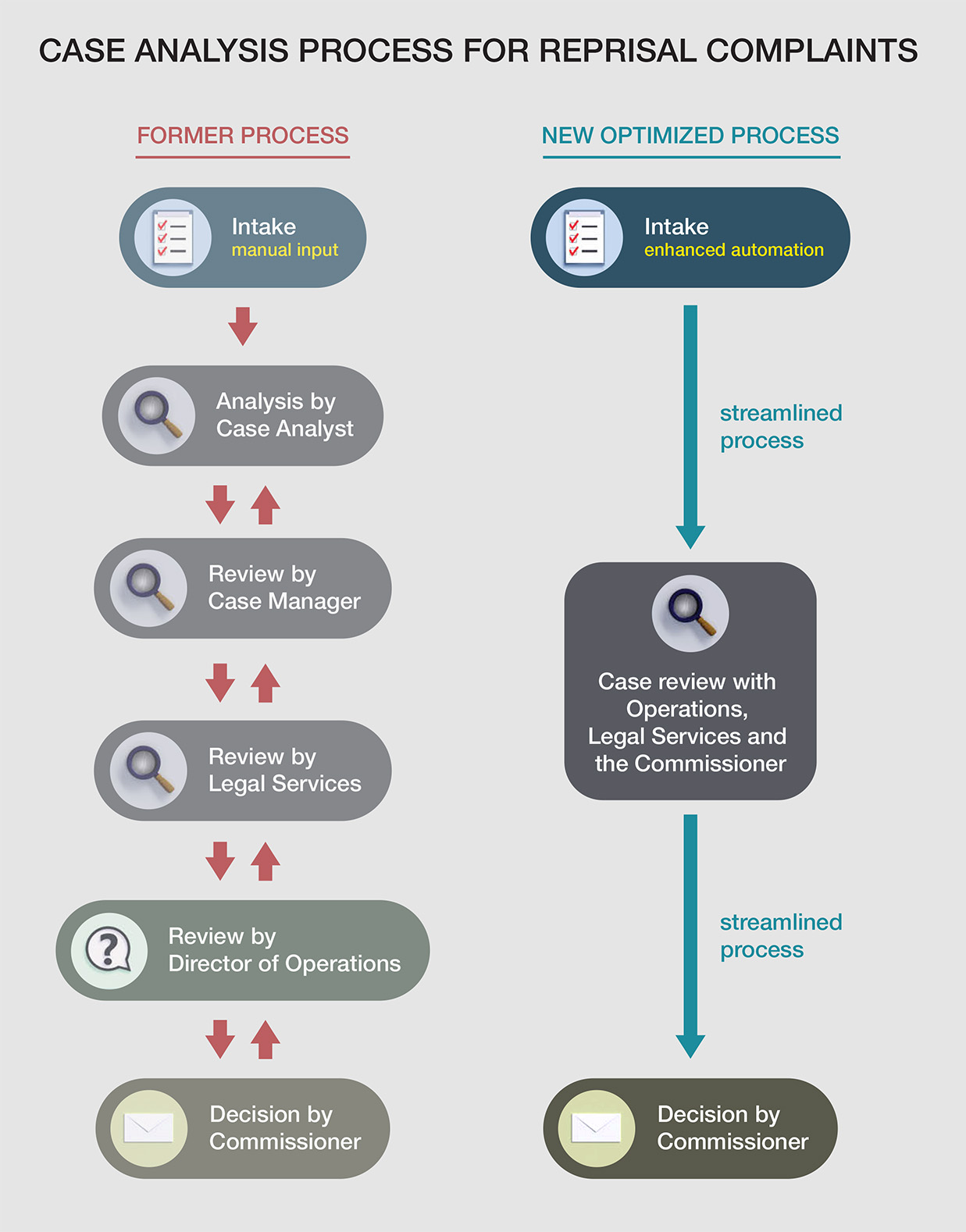
Text version of the image
The image displays two flowcharts of the case analysis process for reprisal complaints. On the left is the flowchart titled “Former Process” that includes six steps showing frequent back-and-forth between steps 2 and 3, steps 3 and 4, and on. Here are the steps:
- Intake (manual input)
- Analysis by Case Analyst
- Review by Case Manager
- Review by Legal Services
- Review by Director of Operations
- Decision by Commissioner
On the right is the flowchart titled “New Optimized Process” that includes three steps showing a direct, streamlined progression. Here are the steps:
- Intake (enhanced automation)
- Case review by Operations, Legal Services and the Commissioner
- Decision by Commissioner
Decisions and Practices Confirmed by Federal Courts
My Office is more than an investigative body, in that I am also required to render quasi-judicial decisions on every disclosure of wrongdoing and reprisal complaint received, as well as on the results of investigations. In every case, this requires me to provide written reasons that are sufficient for the parties to understand how and why the decision was made.
The Courts have long held that the “hallmarks of a reasonable decision” are “justification, transparency and intelligibility.” The Courts, including the Supreme Court of Canada, emphasize that reasons take on a heightened importance “where the stakes are high.” At my Office, this means that investigation reports and the reasons provided to the parties must undergo an extensive, multidisciplinary review process that involves several members of the Operations and Legal Services teams. In the case of founded wrongdoing, the Communications team is also heavily involved in preparing the Case Report to Parliament.
When individuals are dissatisfied with a decision, including on the results of an investigation, they can file a judicial review application with the Federal Court. Judicial review is used to determine if my decision was reasonable, procedurally fair or within my legal jurisdiction. High volumes of submissions, along with delays in investigations explained in the Operational Activities section, inherently increase the risk of litigation arising from files, as my Office faced 13 judicial review applications, among other legal matters in 2025–26.
Numerous court decisions over the years have created a body of law on the interpretation of the Act and have reinforced that my Office’s processes and decisions are reasonable and legally sound. Notably, there were three courts decisions in 2025 that highlight my Office’s work.
In April 2025, the Federal Court in Busby v. Canada (Attorney General), 2025 FC 695, confirmed that “the scope of the Commissioner’s discretion to refuse to deal with—or to cease investigating—a disclosure is extremely broad.” In this case, the Court held that my predecessor’s decision to cease an investigation into allegations of wrongdoing was reasonable when evidence revealed that these had already been investigated by the organization and brought to the attention of senior management. The Court added that the “Commissioner was entitled to decide how much information was needed at the initial stage of the disclosure investigation process” to decide whether the allegations “met the threshold for ‘wrongdoings’ set out in section 8 of the Act and whether a complete investigation was appropriate, considering the criteria set out in subsection 24(1) of the Act.”
On March 30, 2026, the Federal Court of Appeal upheld in Dempsey v. Canada (Attorney General), 2026 FCA 67, an earlier Federal Court decision (2025 FC 245), that found held that a person who makes a disclosure to the Commissioner’s Office has a duty to provide a “clear and cogent narrative” and that it is not the responsibility of this Office “to discern and assess the alleged wrongdoing from a massive volume of poorly organised and confusing materials” to identify relevant information.
The Federal Court of Appeal and the Federal Court also accepted my Office’s interpretation that the Act is not intended to address matters of a personal nature, such as civil litigation claims and other disputes between an individual and the government, especially where there are other redress mechanisms available to deal with those issues.
Outreach and Stakeholder Engagement
Our strategy and ongoing efforts to raise awareness of the Act and my Office among federal public servants, and the Canadian public at large, are the cornerstone of our outreach and engagement strategy. Through a multifaceted approach, we aim to make the submission process accessible and transparent. By targeting our presentations and participation in conferences and events, leveraging our presence on social media platforms, as well as continuing to improve the user experience of our website, we strive to create meaningful connections with our stakeholders and to ensure their understanding of and confidence in the federal whistleblowing regime.
Despite these efforts, we recognise that the protections offered under the Act may remain unknown or misunderstood within the broader federal landscape. This emphasizes the significance of ongoing outreach and clear, consistent communication. We remain committed to expanding our reach and refining our approach to ensure that those who may need our services are able to find, understand and rely on them with confidence.
In 2025–26, we were able to engage with some 6,500 participants over 16 events. We believe that a significant increase in requests for our participation underscores the effectiveness of our approach and highlights the growing interest in my Office and our work.
My Office’s senior officials and I took part in several activities as well, including our participation in Q&A sessions and “Learning Day” panels on themes such as values and ethics, privacy and transparency, as well as recognizing and reporting wrongdoing, which contributes to a more accurate understanding of our work. I also provided a briefing to the Standing Committee on Government Operations and Estimates in October 2025.
The Communications team has advanced work on the redesign of our website, including using graphics and videos to provide an interactive experience. We designed new interactive forms, through which my Office receives most submissions, that guide users through the submission process. We expect to deploy our new website and forms in the early part of 2026–27.
Looking to the Future
Healthy Workplace
The sustained growth in caseload since fall 2023 has placed increasing pressure on employees’ well-being. My Office is operating at capacity, and this ongoing imbalance has contributed to fatigue, stress and a heightened risk of burnout, a reality reflected in the 2024 Public Service Employee Survey’s question on heavy workload being a driver of work-related stress.
In response, my Office undertook an extensive consultation process with all employees to better understand and enhance our Employee Assistance Program. Over the past fiscal year, tools and practical guidance were implemented to better navigate challenges when dealing with the caseload, including training and resources on resiliency, compassion fatigue, and effective communication. These efforts aim to assist all employees to manage stress, maintain work-life balance, and sustain performance in a demanding environment.
At the same time, senior management has taken an active role in supporting employees more directly. Promoting open dialogue and normalizing conversations about mental health have been key, as are reinforcing expectations around respectful communication and encouraging the use of available supports. Recognizing the cumulative impact of sustained operational pressures, my Office’s staff has, together, taken measures that reflect a continued commitment to supporting employee well-being in their day-to-day work.
Funding Requests
Since fall 2023, my Office has sought additional resources through separate funding requests, each resulting in only partial support relative to identified needs. Under Budget 2024, the approved funding represented just over half of what was required, approximately 56% on average per year, to address growing operational pressures. Similarly, the Off-Cycle 2025 request yielded a more limited proportion, with approximately $1.1 million approved against approximately $7.8 million requested, representing less than 15% of the resources sought. While these incremental increases have provided some relief, they have not kept pace with the sustained rise in volume and complexity of cases, leaving significant capacity gaps unaddressed.
In January 2026, my Office submitted another off-cycle funding request to the President of the Treasury Board to secure sustainable funding through the fiscal framework. The request identified incremental and ongoing funding requirements, including onboarding 58 additional employees.
The submission emphasized that my Office’s statutory mandate—to support disclosure of wrongdoing and protect disclosers from reprisal—depends on timely, effective investigations. However, an unprecedented caseload and insufficient resources have led to delays that risk eroding evidence, weakening investigations, and allowing wrongdoing or reprisals to persist. The request highlighted that without adequate funding, there is a risk that my Office may not have the capacity to deliver on its mandate, thereby undermining the accountability framework of the federal public sector.
As cases continue to mount, we will continue to request adequate funding, and this will be key to ensuring the long-term effectiveness of my Office. Without sustained funding, the credibility of the federal whistleblowing regime is at risk.
Operational Activities in 2025–26
Summary of New Submissions
| New general inquiries | 619 |
|---|---|
| New disclosures of wrongdoing | 546 |
| New reprisal complaints | 143 |
Overall Disclosure Activities
| Caseload of disclosures of wrongdoing | 725 |
| 546 |
| 179 |
| Decisions Issued following analysis | 415 |
| 275 |
| 140 |
| Caseload of investigations into a disclosure | 40 |
| 9 |
| 18 |
| 13 |
| Case reports of founded wrongdoing | 1 |
| 1 |
| 0* |
| 0* |
*Note: Recommendations made in case reports are followed up on after six months. We will reflect in the 2026–27 Annual Report our follow-up on the recommendation made in the case report we tabled in December 2025.
Overall Reprisal Activities
| Caseload of reprisal complaints | 151 |
| 143 |
| 8 |
| Decisions issued following analysis | 130 |
| 123 |
| 7 |
| Caseload of investigations into a complaint | 57 |
| 9 |
| 11 |
| 15 |
| 22 |
| Applications to the Public Servants Disclosure Protection Tribunal | 0 |