
2026–27 Departmental Plan
On this page
Copyright information
© His Majesty the King in Right of Canada, as represented by the Office of the Public Sector Integrity Commissioner of Canada, 2026, ISSN 2561-6641
At a glance
This departmental plan details priorities, plans and associated costs of the Office of the Public Sector Integrity Commissioner of Canada (the Office) for the upcoming three fiscal years.
These plans align with the priorities outlined in the Office's Vision, mission, raison d’être and operating context.
Key priorities
The Office’s top priorities for 2026–27 are as follows:
Timeliness and effectiveness
- Seek essential funding to avert the collapse of the independent federal whistleblowing regime and remain an effective deterrent to wrongdoing in the federal public sector
- Optimize internal procedures and resources, as well as promote new operational strategies, as demand outpaces capacity
Awareness and access to information
- Foster better understanding of the Office’s mandate by launching and refining the redesigned website
Comprehensive Expenditure Review
The Office does not have planned reductions under the Comprehensive Expenditure Review.
Highlights for the Office in 2026–27
In 2026–27, the Office will focus on sustaining the effective delivery of the federal whistleblowing regime in the context of persistent growth in disclosures of wrongdoing, complaints of reprisal and general inquiries. The Office will seek critical funding to address a widening capacity gap, as existing reference levels are insufficient to support the timely and effective management of an increasingly complex and expanding caseload. Despite these pressures, the Office will continue to fulfill its statutory mandate by rendering quasi-judicial decisions in reprisal matters and reporting founded cases of wrongdoing to Parliament, while advancing targeted improvements to internal processes and systems to maximize operational efficiency, maintain procedural fairness, and support accountability within the federal public sector.
In 2026–27, total planned spending (including internal services) for the Office is $8,077,875 and total planned full-time equivalent staff (including internal services) is 45.
Summary of planned results
The following provides a summary of the results the department plans to achieve in 2026–27 under its principal areas of activity, called “core responsibilities.”
Core responsibility: Public sector disclosures of wrongdoing and complaints of reprisal
- Planned spending: $5,428,676
- Planned human resources: 36
- Departmental results:
- The Office plans to deliver on its core responsibility by investigating disclosures of wrongdoing and complaints of reprisal, including complex cases that require specialized expertise. It will render quasi-judicial decisions in reprisal matters and report founded cases of wrongdoing to Parliament, thereby reinforcing accountability, transparency, and integrity within the federal public sector.
More information about the Office’s core responsibility, Public sector disclosures of wrongdoing and complaints of reprisal, can be found in the full plan.
For complete information on the Office’s total planned spending and human resources, read the Planned spending and human resources section of the full plan.
From the Commissioner
I am pleased to present the 2026–27 Departmental Plan for the Office of the Public Sector Integrity Commissioner of Canada (the Office).
Beginning in late 2023, the Office has received an unprecedented and now sustained surge in the number of disclosures of wrongdoing, complaints of reprisal and general inquiries. As forecasted through our predictive modelling, the number of submissions continues to climb year after year, placing enormous pressure on our limited resources.
While increased awareness of the Office is positive, a lack of resources to process submissions has created a substantial risk to our mandate and could result in some cases never being investigated. Moreover, delays in investigations can have serious impacts such as the potential loss of evidence or erosion of witness testimony. In addition, each investigation that is delayed creates a risk that wrongdoing or reprisal may be repeated or continued.
A modest injection of funds in 2025, coupled with gains in operational efficiency, resulted in an increase in our capacity to analyze submissions and render decisions about investigations. However, resources still fall far short of what is necessary to handle the existing and growing caseload.
This year, the Office will be seeking essential funding to respond to the ever-increasing number of disclosures of wrongdoing and complaints of reprisal. Communications with the people of Canada are an essential part of our business. The Office will also launch the newly designed website to foster a better understanding of the Office’s mandate. The website is the portal through which nearly all submissions are received. It will be more accessible, more interactive, and will guide users through the submission process.
While awaiting an increase in critical funding, the dedicated and professional members of my team will continue to work diligently to provide the best possible service to the Canadian public, within the limitations of our resources, contributing to an essential part of the accountability and integrity system of the federal public sector.

Harriet Solloway
Commissioner
Plans to deliver on core responsibilities and internal services
Core responsibilities and internal services
Core responsibility: Public sector disclosures of wrongdoing and complaints of reprisal
In this section
Description
The Office of the Public Sector Integrity Commissioner of Canada (the Office) contributes to strengthening accountability and increases oversight of government operations by:
- Providing an independent and confidential process for receiving and investigating disclosures of wrongdoing in, or relating to, the federal public sector from public servants and members of the public;
- Reporting founded cases of wrongdoing to Parliament and making recommendations to chief executives on corrective measures; and
- Exercising quasi-judicial functions in the handling of complaints of reprisal from public servants and former public servants, including rendering decisions, facilitating conciliation where appropriate, and referring cases to the Public Servants Disclosure Protection Tribunal.
Quality of life impacts
The domains from the Quality of Life Framework for Canada that relate the most closely to the Office’s core responsibility, Public sector disclosures of wrongdoing and complaints of reprisal, are:
- Good Governance (primary domain): Public servants will have a mechanism to call out wrongdoing. The Office’s core responsibility contributes to this domain more specifically to the subdomain “Democracy and institutions” through all the activities mentioned in the core responsibility description. The indicator of interest for this domain is “Confidence in institutions.”
- Prosperity: Canadians will be proud of an ethical public sector that ensures good job quality and job satisfaction. The Office’s core responsibility contributes to the subdomain “Employment and job quality,” and the indicator of interest is “Job satisfaction.”
- Society: A robust whistleblowing regime supports social cohesion by ensuring trust in the public sector. The Office’s core responsibility contributes to the subdomain “Social cohesion and connections,” and the indicator of interest is “Trust in others.”
Indicators, results and targets
This section presents details on the Office’s indicators, the actual results from the three most recently reported fiscal years, the targets and target dates for the Office’s core responsibility, Public sector disclosures of wrongdoing and complaints of reprisal. Details are presented by departmental result.
Table 1 provides a summary of the target and actual results for each indicator associated with departmental result 1 under the Office’s core responsibility, Public sector disclosures of wrongdoing and complaints of reprisal.
| Departmental result indicators | Actual results | Target | Date to achieve target |
|---|---|---|---|
| Percentage of cases addressed within established service standards, which are available on the Office’s website |
| The service standards will not be met. | March 2030 |
| Percentage of applications addressed within established service standards under the Legal Access Request Program |
| The service standards will not be met. | March 2030 |
*Note: The Office has implemented four service standards to ensure transparency and provide an objective means of measuring performance. One of these standards is a statutory requirement and must be met 100%, while the other three have a target of 80%. However, the exceptional and sustained surge in activity the Office has faced since fall 2023 is exerting considerable pressure on operational resources, resulting in delays in the processing of files and legal access requests, investigating allegations, and responding to general inquiries.
Table 2 provides a summary of the target and actual results for each indicator associated with departmental result 2 under the Office’s core responsibility, Public sector disclosures of wrongdoing and complaints of reprisal.
| Departmental result indicators | Actual results | Target | Date to achieve target |
|---|---|---|---|
| Percentage of new website visitors |
| 90% of website visitors are new visitors. | March 2027 |
| Number of attendees at outreach events |
| The total number of attendees for the combined events, in which the Office participates in a year, is at least 2,500 attendees. | March 2027 |
*Note: This percentage represents over 89,000 new visitors to the website.
Additional information on the detailed results and performance information for the Office’s program inventory is available on the GC InfoBase Infographic for Results.
Plans to achieve results
The following section describes the planned results for the Office’s core responsibility, Public sector disclosures of wrongdoing and complaints of reprisal, in 2026–27.
Departmental result 1 – Public sector disclosures of wrongdoing and complaints of reprisal are dealt with in a timely and effective manner
A timely and effective process to deal with disclosures of wrongdoing and complaints of reprisal in the federal public sector is essential to the success of the Office. This contributes to our vision of being a trusted organization and meeting our service standards.
Results we plan to achieve:
- The Office will continue to seek additional resources to support operational capacity in response to sustained growth in disclosures of wrongdoing and complaints of reprisal.
- The Office will further optimize its internal procedures and resources, as well as promote new operational strategies to better manage the ever-growing influx of new submissions and growing caseload.
- The Office will make progress toward stabilizing its operational capacity, subject to available resources, in response to sustained growth in disclosures of wrongdoing and complaints of reprisal.
Departmental result 2 – Public servants and members of the public are aware of the Office and have access to information to make an informed decision about disclosures of wrongdoing and complaints of reprisal
Efforts in enhancing public awareness and understanding of the Office’s role and how it delivers on its mandate are crucial to its outreach strategy.
Results we plan to achieve:
- In 2026–27, the Office will continue to take part in activities aimed at better informing public servants and others who might have seen wrongdoing in the federal public sector. Members of the Office will offer presentations and information sessions to federal organizations and attend pertinent conferences and learning events. In addition, the Commissioner will seize opportunities for speaking at events targeted to federal public servants.
- A redesigned website is targeted for completion at the end of 2025–26. In the coming year, we will assess the new website, as well as tracking user data to determine possible improvements.
- Adjustment of new website forms or content as needed to enhance the user experience and decrease the number of submissions that fall outside the Office’s mandate.
Planned resources to achieve results
Table 3 provides a summary of the planned spending and full-time equivalents (FTEs) required to achieve results.
| Resource | Planned |
|---|---|
| Spending | $5,428,676 |
| FTEs | 36 |
Complete financial and human resources information for the Office’s program inventory is available on the GC InfoBase Infographic for Finances and Infographic for People.
Related government priorities
Gender-based Analysis Plus
The Office cannot collect demographic information about disclosers and complainants due to the confidential nature of our work.
The program, designed to provide a mechanism for individuals to report allegations of wrongdoing and reprisal, does not benefit specific groups. Most submissions to the Office are received through an online portal, which is currently being redesigned to increase and improve accessibility and ease of use for all individuals. Those who cannot use electronic or online forms due to the need for accommodations are provided the opportunity to make submissions in alternate formats. For example, an individual can provide the details of their allegations over the phone.
The results of the Office’s investigations may relate to specific groups. For example, a recent finding of wrongdoing related to a Parole Board member who was harassing women in the workplace. By investigating and reporting on this issue, the Office’s work contributed to a safer and more equitable workplace.
United Nations 2030 Agenda for Sustainable Development and the UN Sustainable Development Goals
The Office’s Sustainable Development Strategy and actions support the United Nations’ sustainable development goal of sustainable consumption and production patterns. More specifically and although the impact may be at a small scale, the Office will promote public procurement practices that are sustainable by applying the policy on green procurement of the Government of Canada. This will contribute to achieving the Federal Sustainable Development Strategy target on Greening Government.
More information on the Office’s contributions to Canada’s Federal Implementation Plan on the 2030 Agenda and the Federal Sustainable Development Strategy can be found in the Office’s 2023–27 Departmental Sustainable Development Strategy.
Program inventory
The Office’s core responsibility, Public sector disclosures of wrongdoing and complaints of reprisal, is supported by the Disclosure and Reprisal Management program.
Additional information related to the program inventory for the Office’s core responsibility, Public sector disclosures of wrongdoing and complaints of reprisal, is available on the GC InfoBase Infographic for Results.
Internal services
In this section
Description
Internal services are the services that are provided within a department so that it can meet its corporate obligations and deliver its programs. There are 10 categories of internal services:
- management and oversight services
- communications services
- legal services
- human resources management services
- financial management services
- information management services
- information technology services
- real property management services
- materiel management services
- acquisition management services
Plans to achieve results
This section presents details of the Office’s plans to achieve results and meet targets for internal services.
Finance and acquisition management services
The Office will prepare for significant changes to public-sector financial reporting across government, including the implementation of the new Conceptual Framework and Section PS 1202. In collaboration with central agencies and partners, the Office will update its financial policies, procedures, and systems to comply with these new standards.
As part of its multi-year monitoring plan, the Office will conduct internal audits of financial signing authorities and transfer payments in 2026–27 to support strong governance and accountability.
Human resources management services
In 2025–26, the Office continued to prioritize organizational resilience and operational excellence by reinforcing its internal capacity in Human Resources and Finance. The strategic addition of two key leadership roles—Executive Director and Chief Financial Officer, alongside the Head of Human Resources—marks a significant step toward sustaining departmental effectiveness and supporting the Office’s growing caseload.
Looking ahead, the focus remains on strengthening core operations to ensure agility and responsiveness to an increasing caseload. Growth will be pursued in a fiscally responsible manner, contingent on budgetary considerations, while maintaining a commitment to efficiency, employee well-being, and organizational integrity. These efforts directly support the Office’s overarching goal of delivering high-quality services and fostering a culture of accountability and continuous improvement.
Information technology services
In addition to maintaining current information technology (IT) services, in 2026–27, the Office plans to:
- Maintain and evolve the case management system as a continuous improvement program;
- Improve some of the Office’s processes by leveraging automatization and artificial intelligence; and
- Upgrade the IT infrastructure to increase reliability and security.
Information management services
The Office plans to strengthen practices for information lifecycle management, metadata, retention and disposition to support compliance, privacy, and access to information.
Planned resources to achieve results
Table 4 provides a summary of the planned spending and FTEs required to achieve results.
| Resource | Planned |
|---|---|
| Spending | $2,649,199 |
| FTEs | 9 |
Complete financial and human resources information for the Office’s program inventory is available on the GC InfoBase Infographic for Finances and Infographic for People.
Planning for contracts awarded to Indigenous businesses
To support the Government of Canada’s commitment to awarding at least 5% of the total value of contracts to Indigenous businesses, the Office will strengthen procurement planning and solicitation practices.
The Office will concentrate on early opportunity identification and targeted measures to guarantee that Indigenous suppliers are taken into consideration wherever capability exists, given the Office’s small contractual base and specific procurement needs. This includes:
- Reviewing planned procurements;
- Consulting Indigenous Services Canada’s Indigenous Business Directory during the planning phase to identify and pre-qualify suppliers;
- Strengthening internal procurement planning and coordination to embed Indigenous considerations before solicitation strategies are finalized; and
- Tracking results throughout the fiscal year to adjust strategies.
These measures integrate Indigenous procurement considerations into the Office’s end-to-end procurement process and support the achievement of the 5% target.
Table 5 presents the actual results with forecasted and planned results for the total percentage of contracts the Office awarded to Indigenous businesses.
| 5.00% reporting field | 2024–25 actual result | 2025–26 forecasted result | 2026–27 planned result |
|---|---|---|---|
| Total percentage of contracts with Indigenous businesses | 2.38% | 5.00% | 5.00% |
The results published in the Office’s 2024–25 Departmental Results Report are in line with the 2024–25 actual results mentioned above.
In 2024–25, the Office awarded $8,905 of $374,138 (2.38%) in contracts to Indigenous businesses, which was less than the 5.00% goal set by the Government of Canada. This result reflected the Office’s limited opportunities in specialized procurement sectors and its small contractual base. There were no exclusions.
Key risks
There is a risk that the Office may not have the capacity to deliver on its statutory mandate. The unpredictable nature of file intake and volume means that, in the event of a sudden increase in cases and investigations, the Office runs the risk of not being able to process files in a timely manner. The recent and sustained trend of increasing numbers of new disclosures of wrongdoing and complaints of reprisal each year has significantly impacted the Office’s caseload, which continues to outpace the Office’s resource capacity. The Office’s risk response strategy is to optimize processes for maximum efficiency, closely monitor caseloads as well as human resource capacity, and support ongoing professional development. In addition, the Office is submitting a request for additional funding that would enable it to increase human resource capacity to effectively deliver its mandate in the context of growing trends and caseloads.
The Office faces the risk of not being able to attract, retain and develop the right people with the appropriate mix of skills. The Office’s strategy to mitigate this risk includes proactive recruitment, as well as the use of casual employment and contractors when warranted.
The Office relies on external service providers for many of its corporate functions. This dependency subjects the Office to the risk of service providers not having the capacity to meet our operational needs at any given time. To mitigate this risk, the Office ensures that memoranda of understanding are in place with each service provider that detail both the services and levels of service to be provided. Regular monitoring of service delivery and audits of service level agreements are also conducted.
Furthermore, there is a risk that external and internal threats (including malware, hacking, and errors) could compromise the confidentiality, integrity and availability of sensitive information and business systems, disrupt operations and negatively impact the Office’s ability to deliver on its mandate. To mitigate this risk, the Office is updating its outdated IT infrastructure, using multi-factor authentication across all its critical systems, supporting a new and more reliable case management system, providing quarterly cyber security training for all staff, and reinforcing internal IT capacity.
Planned spending and human resources
This section provides an overview of the Office’s planned spending and human resources for the next three fiscal years and of planned spending for 2026–27 with actual spending from previous years.
Spending
This section presents an overview of the Office’s planned expenditures from 2023–24 to 2028–29.
Budgetary performance summary
Table 6 presents the Office’s spending over the past three years to carry out its core responsibility and internal services. Amounts for the 2025–26 fiscal year are forecasted based on spending to date.
| Core responsibilities and internal services | 2023–24 actual expenditures | 2024–25 actual expenditures | 2025–26 forecast spending |
|---|---|---|---|
| Public sector disclosure of wrongdoing and complaints of reprisal | $4,199,622 | $4,677,242 | $5,344,041 |
| Internal services | $2,577,345 | $2,087,521 | $2,850,638 |
| Total | $6,776,967 | $6,764,763 | $8,194,679 |
Analysis of past three years of spending
Over the period from 2023–24 to 2025–26, spending remained relatively stable between 2023–24 and 2024–25, then are projected to increase by 21% in 2025–26, from $6,776,967 to $8,194,679. This increase is mainly attributable to sustained pressure on the workload and cost normalization required to maintain service levels, driven by higher volumes and complexity of submissions and associated support costs required to deliver the Office’s mandate.
More financial information from previous years is available on the GC InfoBase Infographic for Finances.
Table 7 presents the Office’s planned spending over the next three years for its core responsibility and internal services.
| Core responsibilities and internal services | 2026–27 planned spending | 2027–28 planned spending | 2028–29 planned spending |
|---|---|---|---|
| Public sector disclosure of wrongdoing and complaints of reprisal | $5,428,676 | $5,302,905 | $5,313,561 |
| Internal services | $2,649,199 | $2,706,042 | $2,711,532 |
| Total | $8,077,875 | $8,008,947 | $8,025,093 |
Analysis of the next three years of spending
Over the next three fiscal years, planned spending, based on 2026–27 Draft Main Estimates Report, will remain relatively stable and is expected to be fully utilized. While planned spending aligns with available budget authorities, these levels remain insufficient to support the full implementation of the Office’s statutory mandate. As a result, the Office continues to seek additional funding. Trend analysis confirms that existing reference levels provide limited flexibility in the context of sustained operational pressures.
More detailed financial information on planned spending is available on the GC InfoBase Infographic for Finances.
Funding
This section provides an overview of the Office’s voted and statutory funding for its core responsibility and internal services. For further information on funding authorities, consult the Government of Canada budgets and expenditures.
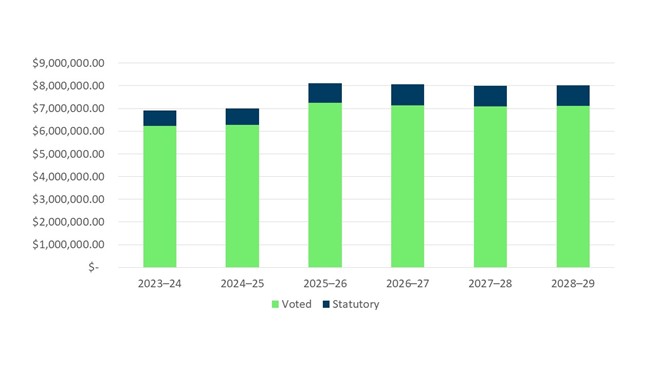
Graph 1 summarizes the Office’s approved voted and statutory funding from 2023–24 to 2028–29.
Text description of graph 1
Graph 1 illustrates the Office’s voted and statutory funding for fiscal years 2023–24 to 2028–29.
| Fiscal year | Total | Voted | Statutory |
|---|---|---|---|
| 2023–24 | $6,915,699 | $6,234,919 | $680,780 |
| 2024–25 | $7,002,825 | $6,283,184 | $719,641 |
| 2025–26 | $8,101,956 | $7,248,210 | $853,746 |
| 2026–27 | $8,077,875 | $7,147,940 | $929,935 |
| 2027–28 | $8,008,947 | $7,090,401 | $918,546 |
| 2028–29 | $8,025,093 | $7,106,547 | $918,546 |
Analysis of statutory and voted funding over a six-year period
Funding trend analysis: Over the past three fiscal years, total approved funding increased from $6,915,699 in 2023–24 to $8,101,956 in 2025–26. This increase is primarily attributable to higher voted funding to support operational requirements, along with growth in statutory funding related to employee benefit plans. The most significant year-over-year increase occurs between 2024–25 and 2025–26, reflecting adjustments to approved authorities to address sustained workload pressures.
Projections: Over the next three fiscal years (from 2026–27 to 2028–29), total approved funding is expected to remain relatively stagnant, around $8.0–8.1 million annually. This amount is projected to be fully utilized and provides limited flexibility to respond to sustained or emerging pressures. Consequently, the Office has submitted a budget request to the Department of Finance to support the effective delivery of its statutory mandate.
For further information on the Office’s departmental appropriations, consult the 2026–27 Main Estimates.
Future-oriented condensed statement of operations
The future-oriented condensed statement of operations provides an overview of the Office’s operations for 2025–26 to 2026–27.
Table 8 summarizes the expenses and revenues net to the cost of operations before government funding and transfers for 2025–26 to 2026–27. The forecast and planned amounts in this statement of operations were prepared on an accrual basis. The forecast and planned amounts presented in other sections of the Departmental Plan were prepared on an expenditure basis. Amounts may therefore differ.
| Financial information | 2025–26 forecast results | 2026–27 planned results | Difference (forecasted results minus planned) |
|---|---|---|---|
| Total expenses | $8,787,140 | $9,289,744 | $502,604 |
| Total revenues | $0 | $0 | $0 |
| Net cost of operations before government funding and transfers | $8,787,140 | $9,289,744 | $502,604 |
Analysis of forecasted and planned results
The $502,604 increase in the net cost of operations and planned expenditures in 2025–26 and 2026–27 is mainly attributable to the planned recruitment of additional FTE resources in 2026–27 to respond to sustained growth in operational demand, as well as the inclusion of an estimated carry forward from 2025–26 in the 2026–27 planned results. These factors have an impact on both salary-related costs (including employee benefit expenses) and operating and maintenance expenses.
A more detailed Future-Oriented Statement of Operations and associated Notes for 2026–27, including a reconciliation of the net cost of operations with the requested authorities, is available on the Office’s website.
Human resources
This section presents an overview of the Office’s actual and planned human resources from 2023–24 to 2028–29.
Table 9 shows a summary of human resources, in FTEs, for the Office’s core responsibility and internal services for the previous three fiscal years. Human resources for the 2025–26 fiscal year are forecasted based on year to date.
| Core responsibilities and Internal Services | 2023–24 actual FTEs | 2024–25 actual FTEs | 2025–26 forecasted FTEs |
|---|---|---|---|
| Public sector disclosure of wrongdoing and complaints of reprisal | 25 | 29 | 29 |
| Internal services | 8 | 8 | 11 |
| Total | 33 | 37 | 40 |
Analysis of human resources over the last three years
Growth in FTEs for internal services: The total number of FTEs increased from 33 in 2023–24 to 40 in 2025–26. While FTEs supporting the Office’s Public sector disclosure of wrongdoing and complaints of reprisal remained stable at 29, the number of FTEs assigned to internal services increased from 8 to 11. This growth reflects the need to strengthen internal capacity to meet growing operational demand and enable the Office to effectively fulfill its mandate.
Table 10 shows information on human resources, in FTEs, for the Office’s core responsibility and internal services planned for the next three years.
| Core responsibilities and Internal Services | 2026–27 planned FTEs | 2027–28 planned FTEs | 2028–29 planned FTEs |
|---|---|---|---|
| Public sector disclosure of wrongdoing and complaints of reprisal | 36 | 36 | 36 |
| Internal services | 9 | 9 | 9 |
| Total | 45 | 45 | 45 |
Analysis of human resources for the next three years
Capacity pressures: The staffing level of 36 FTEs for the core responsibility, Public sector disclosure of wrongdoing and complaints of reprisal, and 9 FTEs for internal services over the 2026–27 to 2028–29 period does not reflect the sustained growth in operational demand.
The Office is experiencing an unprecedented number of allegations of wrongdoing and reprisal that exceed available resources, resulting in delays in investigations and limiting its ability to absorb additional workload. These pressures are expected to persist throughout the planning period and continue to affect the timely execution of the Office’s legislative mandate.
Given these sustained pressures on capacity, the Office has submitted an off-cycle funding request to the Treasury Board Secretariat on January 15, 2026, for transmission to the Department of Finance through the President of the Treasury Board Secretariat. This request represents an essential investment to support effective oversight, ensure accountability, and strengthen Canadians’ confidence in the entire federal public sector.
Corporate information
Departmental profile
Appropriate minister
The Honourable Shafqat Ali, President of the Treasury Board
Institutional head
Harriet Solloway, Public Sector Integrity Commissioner
Ministerial portfolio
Treasury Board
Enabling instrument
Year of incorporation / commencement
2007
Other
The Office supports the Commissioner, who is an independent Agent of Parliament.
Departmental contact information
Mailing address
PO Box 987
Ottawa PO B, Ontario K1P 5R1
Telephone
613-941-6400 or 1-866-941-6400 (toll-free)
Website
Supplementary information tables
The supplementary information table Details on transfer payment programs is available on the Office’s website.
Information on the Office’s departmental sustainable development strategy can be found on the Office’s website.
Federal tax expenditures
The Office’s Departmental Plan does not include information on tax expenditures.
The tax system can be used to achieve public policy objectives through the application of special measures such as low tax rates, exemptions, deductions, deferrals and credits. The Department of Finance publishes cost estimates and projections for these measures each year in the Report on Federal Tax Expenditures.
This report also provides detailed background information on tax expenditures, including descriptions, objectives, historical information and references to related federal spending programs as well as evaluations and the Gender-based Analysis Plus of tax expenditures.
Definitions
List of terms
appropriation (crédit)
Any authority of Parliament to pay money out of the Consolidated Revenue Fund.
budgetary expenditures (dépenses budgétaires)
Operating and capital expenditures; transfer payments to other levels of government, organizations or individuals; and payments to Crown corporations.
core responsibility (responsabilité essentielle)
An enduring function or role performed by a department. The intentions of the department with respect to a core responsibility are reflected in one or more related departmental results that the department seeks to contribute to or influence.
Departmental Plan (plan ministériel)
A report on the plans and expected performance of an appropriated department over a 3 year period. Departmental Plans are usually tabled in Parliament each spring.
departmental result (résultat ministériel)
A consequence or outcome that a department seeks to achieve. A departmental result is often outside departments’ immediate control, but it should be influenced by program-level outcomes.
departmental result indicator (indicateur de résultat ministériel)
A quantitative measure of progress on a departmental result.
departmental results framework (cadre ministériel des résultats)
A framework that consists of the department’s core responsibilities, departmental results and departmental result indicators.
Departmental Results Report (rapport sur les résultats ministériels)
A report on a department’s actual accomplishments against the plans, priorities and expected results set out in the corresponding Departmental Plan.
fulltime equivalent (équivalent temps plein)
A measure of the extent to which an employee represents a full person year charge against a departmental budget. For a particular position, the fulltime equivalent figure is the ratio of number of hours the person actually works divided by the standard number of hours set out in the person’s collective agreement.
Gender-based Analysis Plus (GBA Plus) (Analyse comparative entre les sexes Plus [ACS Plus])
Is an analytical tool used to support the development of responsive and inclusive policies, programs, and other initiatives. GBA Plus is a process for understanding who is impacted by the issue or opportunity being addressed by the initiative; identifying how the initiative could be tailored to meet diverse needs of the people most impacted; and anticipating and mitigating any barriers to accessing or benefitting from the initiative. GBA Plus is an intersectional analysis that goes beyond biological (sex) and socio-cultural (gender) differences to consider other factors, such as age, disability, education, ethnicity, economic status, geography (including rurality), language, race, religion, and sexual orientation.
Using GBA Plus involves taking a gender- and diversity-sensitive approach to our work. Considering all intersecting identity factors as part of GBA Plus, not only sex and gender, is a Government of Canada commitment.
government priorities (priorités gouvernementales)
For the purpose of the 2025-26 Departmental Plan, government priorities are the high-level themes outlining the government’s agenda in the November 23, 2021, Speech from the Throne: building a healthier today and tomorrow; growing a more resilient economy; bolder climate action; fight harder for safer communities; standing up for diversity and inclusion; moving faster on the path to reconciliation; and fighting for a secure, just and equitable world.
horizontal initiative (initiative horizontale)
An initiative where two or more federal departments are given funding to pursue a shared outcome, often linked to a government priority.
Indigenous business (enterprise autochtones)
For the purpose of the Directive on the Management of Procurement Appendix E: Mandatory Procedures for Contracts Awarded to Indigenous Businesses and the Government of Canada’s commitment that a mandatory minimum target of 5% of the total value of contracts is awarded to Indigenous businesses, an organization that meets the definition and Arequirements as defined by the Indigenous Business Directory.
non‑budgetary expenditures (dépenses non budgétaires)
Net outlays and receipts related to loans, investments and advances, which change the composition of the financial assets of the Government of Canada.
performance (rendement)
What an organization did with its resources to achieve its results, how well those results compare to what the organization intended to achieve, and how well lessons learned have been identified.
performance indicator (indicateur de rendement)
A qualitative or quantitative means of measuring an output or outcome, with the intention of gauging the performance of an department, program, policy or initiative respecting expected results.
plan (plan)
The articulation of strategic choices, which provides information on how an organization intends to achieve its priorities and associated results. Generally, a plan will explain the logic behind the strategies chosen and tend to focus on actions that lead to the expected result.
planned spending (dépenses prévues)
For Departmental Plans and Departmental Results Reports, planned spending refers to those amounts presented in Main Estimates.
A department is expected to be aware of the authorities that it has sought and received. The determination of planned spending is a departmental responsibility, and departments must be able to defend the expenditure and accrual numbers presented in their Departmental Plans and Departmental Results Reports.
program (programme)
Individual or groups of services, activities or combinations thereof that are managed together within the department and focus on a specific set of outputs, outcomes or service levels.
program inventory (répertoire des programmes)
Identifies all the department’s programs and describes how resources are organized to contribute to the department’s core responsibilities and results.
result (résultat)
A consequence attributed, in part, to an department, policy, program or initiative. Results are not within the control of a single department, policy, program or initiative; instead they are within the area of the department’s influence.
statutory expenditures (dépenses législatives)
Expenditures that Parliament has approved through legislation other than appropriation acts. The legislation sets out the purpose of the expenditures and the terms and conditions under which they may be made.
target (cible)
A measurable performance or success level that an organization, program or initiative plans to achieve within a specified time period. Targets can be either quantitative or qualitative.
voted expenditures (dépenses votées)
Expenditures that Parliament approves annually through an appropriation act. The vote wording becomes the governing conditions under which these expenditures may be made.